
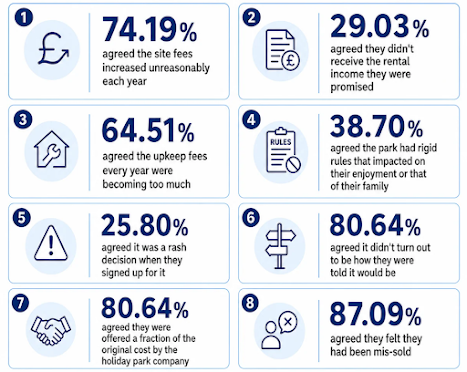
WHAT PARKDEAN OWNERS TOLD US
We surveyed Parkdean owners about their experience with site fees, letting income, resale and how their ownership matched what they were told before buying. The results were striking — most said their fees rose faster than expected, their letting income fell short of what was promised, and resale offers came in far below what they’d paid. If any of this sounds familiar, you’re not alone — and it may be worth finding out where you stand.
If you were mis-sold a static caravan or holiday lodge, or you’ve lost money to unclear fees, resale problems, hidden charges, upgrade pressure or unfair contract terms – find out where you stand.
Over 1,800 cases for holiday park home owners are currently being processed!
Start your free, no obligation assessment by filling out the short contact form…
Feedback we received from parkdean owners
The site fees were incorrect, I was told when I was put under pressure to sign.. when I challenged this prior to signing.. The sales manager sent me a email from him and the site manager of the site to say the ground fees on my contract would not be what I pay as they will discount them, when it came to following year to pay my site fees would not reduce them to the agreed amount said if I didn’t pay, they would take my caravan off site.
Misrepresentation being lied to by the sales representative about numerous factors in the sales process which led to significant personal financial loss.
For the way I have been treated from the very first caravan that I got from Parkdean, they are a very cut throat company, unwilling to help anyone, unwilling to help but willing to charge through the nose for the benefit of being there, it is like their staff have been trained to treat owners like they don’t matter and all that matters is the customers they get through the door, you are given no choice but to rent your vans out and then they force you out due to rising fees.
The fees and rental income not matching anywhere near what the sales people told us.
Parkdean operates more parks than it currently offers for ownership
Parkdean Resorts UK Limited currently operates and manages 65 parks within a group structure involving several park-owning companies. As of July 2026, Parkdean promotes holiday-home ownership at 56 locations and refers to around 20,000 owners.
Current ownership parks include Trecco Bay, Warmwell, Whitley Bay, Cayton Bay, Newquay, Sandford, Camber Sands, Nodes Point, Romney Sands, Thorness Bay, Fallbarrow, White Cross Bay, Ty Mawr and many others.
Parkdean Resorts UK Limited is an active company registered under company number 05729719. Because different group companies own individual parks, the exact company in an agreement may depend on the location and purchase date.
Owners should use the company, park, pitch and licence shown in their own documents.
Were the annual pitch fees and running costs represented accurately?
Parkdean’s current guidance states that its 2026 site fees range from £3,250 to £12,495 per year, depending on the park, pitch and holiday home. It also explains that longer seasons and premium pitches can carry higher fees.
This wide range shows why a general ownership estimate may be insufficient.
The circumstances may deserve closer assessment where:
- The buyer was given a group-wide estimate rather than the actual selected-pitch fee.
- A temporary free-fee offer obscured the normal annual charge.
- The basis for future increases was not explained.
- Utilities, safety testing, local charges or maintenance were omitted.
- The buyer was pressured to proceed before receiving the complete cost breakdown.
Keep the park-specific quotation, pitch-fee schedule, agreement and later statements.
Did a letting scheme make ownership look less expensive?
Parkdean promotes managed letting schemes as a way for owners to offset running costs. Current information also states that letting earnings may be applied against the following year’s pitch fee before any balance is paid to the owner.
A possible claim issue may arise where a specific income representation materially influenced the purchase and the conditions were not explained properly.
That may include situations where:
- Letting was presented as covering the pitch fee with little uncertainty.
- A particular annual return was treated as dependable.
- The required letting availability was not made clear.
- Deductions or the timing of payments were not explained.
- The written letting arrangement differed from what was described before purchase.
Keep the original income illustration, letting agreement, availability calendar and annual statements.
Did the quoted site fee or park-specific cost make the purchase appear more manageable?
The quotation, pitch agreement and later statements may help show whether the full commitment was explained accurately.
Were resale, private sale and part-exchange options clear?
Parkdean’s current guidance says an owner may be able to sell the holiday home to Parkdean, part exchange it or arrange a private sale through the park. It also states that an existing caravan from another operator cannot normally be moved onto a Parkdean park, although part exchange may be offered.
A potential claim concern may arise where the buyer relied on a clear statement that:
- Parkdean would buy the holiday home back at a favourable value.
- A private sale could be arranged without significant restrictions.
- The caravan could later be moved to another Parkdean park.
- Part exchange would preserve a defined level of value.
- A future upgrade would always provide a practical exit.
A low offer or restricted route does not automatically prove mis-selling. The relevant question is whether the sales representation was materially different from the agreement and later position.
Keep valuations, private-sale guidance, buyback responses and part-exchange quotations.
Was the tenure of the holiday home explained consistently?
Parkdean’s current public materials use more than one summary of tenure. Its ownership FAQ says that a brand-new holiday home is generally subject to a licence of around 20 years, while the current Parkdean Promise refers to a minimum 15-year tenure for a new holiday home.
Those statements are general current guidance. The signed licence remains the decisive document for an individual owner.
The circumstances may require assessment where:
- A specific 20-year or other term was promised.
- The written licence provided a shorter minimum period than the buyer understood.
- The effect of caravan condition or park standards was not explained.
- Renewal or continued siting was presented as automatic.
- Removal or termination was threatened on a basis that conflicted with the sales presentation.
Parkdean currently states that owners may discuss upgrading after at least three months of ownership. That current eligibility rule does not prove that an individual buyer was promised a particular future upgrade value.
When might a Parkdean ownership problem support a claim?
The circumstances may be worth assessing where:
- A statement about site fees, letting, season length, resale or tenure materially influenced the purchase.
- The actual park-specific costs were materially different from the sales illustration.
- A long season was presented as permanent residence.
- The written agreement differed from the sales explanation.
- The owner suffered measurable loss after relying on the information provided.
Not every fee increase, letting shortfall or resale loss will support a claim. Each case depends on the evidence and the agreement applying to that park.
Which Parkdean documents may help?
Keep:
- The sales order and purchase agreement.
- The pitch licence and park rules.
- The company and park names shown in the agreement.
- The park-specific site-fee quotation.
- Free or discounted pitch-fee offer terms.
- Annual statements and other ownership-cost records.
- Sales brochures, advertisements and saved webpages.
- Emails, messages and notes of sales conversations.
- A timeline showing what was said and what happened later.
Did a letting scheme make ownership look less expensive?
Parkdean promotes managed letting schemes as a way for owners to offset running costs. Current information also states that letting earnings may be applied against the following year’s pitch fee before any balance is paid to the owner.
A possible claim issue may arise where a specific income representation materially influenced the purchase and the conditions were not explained properly.
That may include situations where:
- Letting was presented as covering the pitch fee with little uncertainty.
- A particular annual return was treated as dependable.
- The required letting availability was not made clear.
- Deductions or the timing of payments were not explained.
- The written letting arrangement differed from what was described before purchase.
Keep the original income illustration, letting agreement, availability calendar and annual statements.
FAQ
Does Parkdean operate 65 or 56 parks?
Parkdean currently states that it operates and manages 65 parks, while holiday-home ownership is promoted at 56 locations. Not every holiday park offers the same ownership opportunities.
How much are Parkdean site fees?
Parkdean’s current 2026 guide states a range of £3,250 to £12,495 a year. The actual fee depends on the park, pitch and holiday home.
Does a 12-month Parkdean season permit permanent residence?
No automatic residential right follows from a 12-month season. Parkdean describes its holiday homes as non-residential and applies park-specific pitch terms.
What if I was told letting would cover the pitch fee?
Keep the projection and complete letting terms. The claim issue may arise where the representation materially influenced the purchase and the conditions or variability were not explained.
Can I sell my Parkdean holiday home privately?
Parkdean’s current guidance says a private sale may be arranged through the park. The exact process and restrictions should be checked against the agreement.
Can I move a caravan from another park onto a Parkdean park?
Parkdean currently says an existing holiday home from another park cannot normally be moved onto its parks, although part exchange may be available.
Is Parkdean tenure 15 or 20 years?
Current public materials use both a minimum 15-year statement and a general guide of about 20 years for a new holiday home. The signed licence for the individual purchase is central.
Can a former Parkdean owner still have a potential claim?
Potentially. Former owners may retain the agreement, fee statements, letting records, valuations and evidence of loss on sale or part exchange.
Start your claim assessment enquiry
Complete the form below and tell Holiday Park Advice Centre what happened with your holiday park ownership. If you were misled, charged unexpected fees, pressured to upgrade or blocked from selling your holiday caravan or lodge, Holiday Park Advice Centre can help you understand whether your situation may be relevant to a potential claim.