
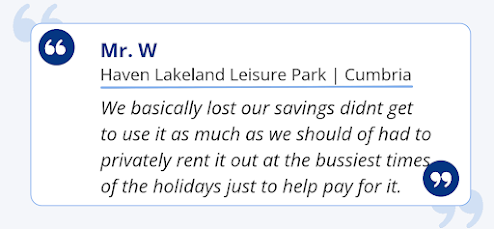
WHAT HAVEN OWNERS TOLD US
If you were mis-sold a static caravan or holiday lodge, or you’ve lost money to unclear fees, resale problems, hidden charges, upgrade pressure or unfair contract terms – find out where you stand.
Over 1,800 cases for holiday park home owners are currently being processed!
Start your free, no obligation assessment by filling out the short contact form…
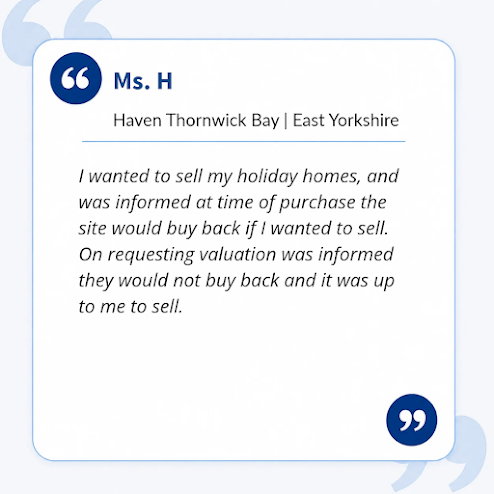
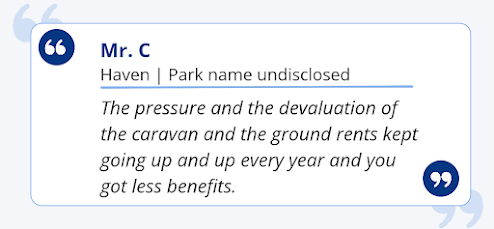
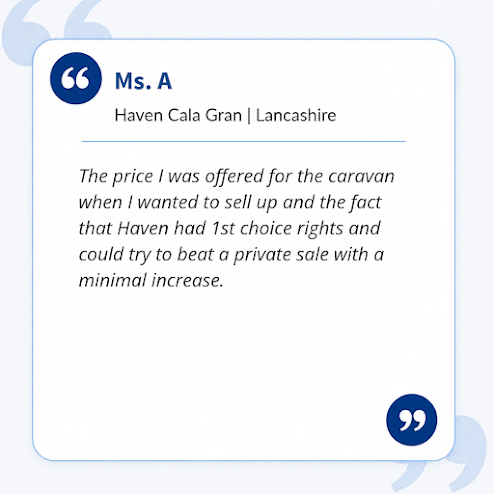
The Haven name covers many different ownership situations
As of July 2026, Haven lists 38 holiday parks around the coasts of England, Scotland and Wales. Its locations include Devon Cliffs, Perran Sands, Rockley Park, Primrose Valley, Hopton, Craig Tara, Hafan y Môr, Presthaven and Kiln Park.
The park matters. Opening seasons, site fees, letting demand, facilities, pitch terms and local resale conditions may differ from one location to another. The terms that applied when the holiday home was purchased may also differ from Haven’s current public information.
Owners should therefore start with their own documents rather than assume that a general statement about Haven applies to every park or every purchase date.
Haven Leisure Limited may appear in the purchase agreement or pitch paperwork. It is an active company registered in England and Wales under company number 01968698. The exact company and park names shown in the original documents can help identify the transaction, but they do not by themselves indicate that anything was wrong.
Were the real annual costs clear before you signed?
The price of the caravan or lodge is only one part of the cost of ownership. Haven’s current guidance separates the purchase price from annual site fees and other running costs.
For a potential claim, the issue is not simply that fees exist or that costs later increased. The relevant question is whether the sales presentation gave the buyer a fair and accurate understanding of the commitment they were taking on.
The circumstances may deserve closer attention where:
- The overall cost was presented mainly as a weekly or monthly figure.
- A discounted or fee-free period gave an unrealistic impression of the longer-term cost.
- Compulsory charges were omitted, minimised or presented as optional.
- The basis on which site fees could change was not clearly explained.
- The buyer was pressured to proceed before having enough time to examine the figures and agreement.
The strongest comparison is usually between the original quotation, the sales material, the pitch agreement and the charges that followed.
Did letting income make the ownership costs look manageable?
Haven currently offers its own letting service and promotes Let2offset. Haven describes Let2offset as a contractual letting product that provides eligible owners with an annual letting amount, calculated under the terms applying to that year, which is then credited against site fees.
The existence of a letting scheme is not itself a problem. A potential claim concern may arise when a specific income figure or promise materially influenced the purchase and the important conditions were not properly explained.
That may include situations where:
- Letting was presented as covering all or most site fees.
- A specific annual return was treated as dependable rather than illustrative.
- The number of dates that had to be made available was not made clear.
- The effect of keeping popular dates for personal use was not properly explained.
- The written letting arrangement differed materially from the explanation given during the sale.
Useful records may include the original income illustration, Let2offset agreement, letting terms, owner-use calendar, annual statements and messages discussing the expected result.
Were you told you could use the holiday home all year?
Haven sells caravans and lodges as holiday homes, not permanent residences. As of July 2026, its published guidance states that an owner may occupy a Haven holiday home for up to 60 consecutive days at a time. Park opening periods also vary.
A long season is not the same as permission to use the caravan as a main home. The pitch agreement, park rules, planning position and sales explanation all matter.
A possible mis-selling concern may arise where the buyer was clearly told that they could:
- Live at the park permanently.
- Use the holiday home as their only or main residence.
- Treat a long opening season as unrestricted residential use.
- Remain at the park throughout the year without meaningful holiday-use restrictions.
- Use the park address as evidence that the caravan was being sold as a permanent home.
The important issue is what was represented before the purchase and whether that representation was consistent with the written terms.
Did resale or part exchange sound safer than it proved?
Haven currently promotes part exchange and provides information about moving an existing caravan to a Haven park. These current services provide useful context, but they do not establish what an individual buyer was promised during an earlier sale.
A potential claim concern may arise where the buyer relied on a clear statement that:
- The holiday home would be easy to sell.
- A favourable buyback or part-exchange value would be available.
- The caravan would retain a particular proportion of its purchase price.
- Leaving ownership would be straightforward and inexpensive.
- Upgrading would always provide a practical exit from an older caravan.
Haven’s own published guidance acknowledges that static caravans can depreciate quickly and describes ownership as a lifestyle choice rather than a conventional investment. A normal fall in value does not automatically support a claim. The issue becomes more significant where the sales presentation gave a materially different impression of future value, resale or the ease of leaving ownership.
Keep the original valuation or illustration, later resale or part-exchange offers, correspondence about selling and any notices explaining deductions or restrictions.
Other long-term Haven ownership concerns
Was the expected life of the caravan explained accurately?
A generic “20-year rule” does not accurately describe every Haven agreement.
Haven’s current published guidance states that the initial pitch-licence period is 12 years and that it may be extended. It also says that the condition and maintenance of the holiday home can affect how long it remains on the park.
The owner’s actual position depends on the agreement signed at the time, together with any later extension, variation, inspection or park-specific notice. Current website wording does not replace an older contract.
The circumstances may be relevant where:
- The salesperson described ownership as lasting for a specific period.
- The expected number of years materially influenced the purchase decision.
- The pitch licence was shorter or more conditional than the buyer understood.
- An extension was presented as routine but was later refused.
- Removal or termination was threatened in a way that conflicted with the original sales explanation.
A park may have legitimate safety, condition or contractual concerns. The potential claim issue is whether the original representation was accurate and whether a materially different position later caused pressure or loss.
What can turn a Haven ownership problem into a potential claim?
A Haven ownership concern may be worth assessing where the available evidence suggests that:
- A specific statement about costs, letting income, permitted use, value, resale or ownership length materially influenced the purchase.
- Important fees, restrictions or conditions were omitted or minimised.
- The written agreement was materially different from the sales explanation.
- The buyer was pressured to sign, upgrade or commit before understanding the full position.
- The owner suffered a measurable loss after relying on the information provided.
Not every complaint, fee increase or resale loss will support a claim. Each situation depends on what was represented, what appears in the documents and what loss followed.
Which documents can help show what happened?
Keep as much of the original paper trail as possible, including:
- The sales order and purchase agreement.
- The pitch licence and any extension or variation.
- Park rules and owner handbooks from the relevant period.
- Sales brochures, advertisements, saved webpages and price illustrations.
- Emails, messages and notes of calls or sales meetings.
- Letting projections, Let2offset paperwork and annual statements.
- Site-fee schedules, annual statements and charge notices.
- Utility, water, rates and other ownership-cost records.
- A clear timeline of what was said, what changed and what loss followed.
FAQ
Can I claim simply because Haven increased my site fees?
An increase alone does not automatically establish a claim. The relevant questions include what was said about future costs, how the agreement allowed fees to change and whether the sales presentation gave a materially misleading impression of the long-term commitment.
What if I was told that letting would cover my site fees?
Keep the original illustration and the complete letting terms. A specific promise may be relevant where it materially influenced the purchase and the required letting dates, annual recalculation or other important conditions were not properly explained.
What if I believed I could live in my Haven holiday home permanently?
Keep the pitch agreement, park rules, brochures, messages and any record of the sales conversation. If permanent or unrestricted residence was clearly represented but the written terms allowed holiday use only, the discrepancy may be relevant to a mis-selling claim.
Does Haven’s current 12-year pitch-licence wording apply to my agreement?
Not necessarily. The agreement signed at the time and any later extension or variation will be central. Haven’s current published position is useful context, but it does not automatically change historic terms.
What if I have been asked to upgrade or remove the caravan?
Check the reason given and the exact wording of the pitch licence. Condition, safety, licence expiry and park-specific terms may all be relevant. The concern may require closer assessment where the action conflicts with a clear sales promise or where misleading pressure was applied.
Can a low resale or part-exchange offer support a claim?
A low offer by itself does not prove mis-selling. It may become relevant where a clear statement about future value, buyback, resale or part exchange materially influenced the purchase and the later position was substantially different.
Can a former Haven owner still have a potential claim?
Potentially. A former owner may still have the agreement, statements, valuations, correspondence and records showing the loss suffered when the holiday home was sold or part exchanged.
Start your claim assessment enquiry
Complete the form below and tell Holiday Park Advice Centre what happened with your holiday park ownership. If you were misled, charged unexpected fees, pressured to upgrade or blocked from selling your holiday caravan or lodge, Holiday Park Advice Centre can help you understand whether your situation may be relevant to a potential claim.